

Our History
1837
THE BEGGININGS - Unveiling the origins of a legacy
In June 1837, Milan was the capital of the Kingdom of Lombardy-Venetia under Austrian rule. The city counted around five hundred thousand inhabitants and aspired, on the one hand, to be a modern nineteenth-century capital with a Central European character and, on the other, to become a cradle of the Italian Risorgimento. It was in this context, on the rural outskirts south of Milan, in Noviglio, that the entrepreneurial adventure of the Ghella family began. On 26 June 1837, Domenico Ghella was born.
1867
EVOLUTION - Birth of the pioneering spirit
Meanwhile, the Industrial Revolution expanded relations and opportunities. It was also during these years that the great nineteenth-century ideologies began to take shape and clash. Domenico — who moved from Suez to Istanbul — adapted to the changing times, developing that explorer’s spirit which would thereafter become a defining value of Ghella. Work on the Suez Canal lasted until 1871: only three years, yet decisive in shaping his openness and curiosity towards the world. That desire to discover, to learn, and to go beyond known boundaries, which Domenico permanently added to the set of values that would define the future company. In 1871 he left Port Said but remained within the Ottoman Empire. He learned that in Istanbul the Sultan was building an underground funicular railway linking the central districts of Beyoğlu and Karaköy, ancient Galata, the historic heart of the city on the European side. The Tünel, as it is known today in Turkey, runs for 573 metres up the hill overlooking the Golden Horn: at the time, only the London Underground, inaugurated in 1863, surpassed such an undertaking in scale.
1894
LAYING THE FOUNDATIONS - Domenico returns to Italy and Ghella is founded
Domenico returned to Piedmont, where his son Adolfo was born on 17 August 1877. Together they would found the company we know today. Destined to inherit the business at a young age, Adolfo enriched his father’s spirit and vision with a sober character, yet sufficiently bold to dare, typical of the Piedmontese. He followed his father to construction sites, quickly gaining experience and, above all, developing an entrepreneurial vision. Like Domenico, he too would leave his homeland at the age of thirteen, driven by that same spirit of adventure which would take him to the far corners of the globe, from Australia to Russia.


1906–07
THE FIRST GREAT BET WON – Beacon Hill: the longest tunnel in China
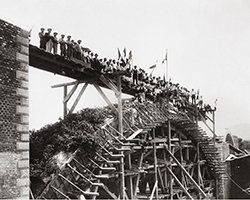
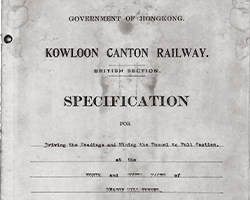
At the beginning of the twentieth century, Hong Kong — which had become a British colony after the Opium War — was transforming from a small fishing port into a strategic center of the British Empire in China, a modern city undergoing rapid economic expansion. In 1907, construction began on the first railway line between Hong Kong and Canton (today’s East Rail Line), a 100-kilometre infrastructure destined to become a fundamental link between the colony and mainland China. The crucial phase was the construction of the two-kilometer tunnel beneath Beacon Hill, between Kowloon Tong and Tai Wai. The project proved extremely complex: the ground was exceptionally hard, costs were rising, and diverting the railway line would have been too expensive. Arriving on site in 1907, Adolfo proposed an innovative solution: constructing a vertical shaft to facilitate excavation under Hong Kong’s rocky terrain. He overcame technical difficulties, ventilation problems, and even cultural resistance linked to Feng Shui, recruiting Indian workers and securing the necessary financing. The gamble paid off: the tunnel was completed, and the railway inaugurated in 1910. At the time, it represented the largest civil engineering project ever undertaken in Asia and marked Adolfo’s definitive entrepreneurial success.
1915
THE ART OF REGENERATION - Starting from the ground up, as often as necessary
In Russia, the war brought construction sites to a halt. Adolfo reinvented himself in the carpet trade, maintaining his connections with the Caucasus and moving between Moscow and St. Petersburg. But the Bolshevik Revolution overturned everything. Trapped in St. Petersburg, he came to terms with the harsh reality that his investment had failed. For the second time in three years, he was forced to rebuild from the ground up. At the end of 1919, he returned to Italy under extremely difficult circumstances, leaving through the port of Archangelsk on the White Sea. Yet even at home, the situation was dire: after four years of war, the country was on the brink of bankruptcy and there was little work to be found. Determined not to stand still, he attempted to revive the textile trade in Azerbaijan, drawing on his deep knowledge of the Caucasus. Once again, however, political instability and broken promises brought the operation to a halt. He was forced to flee and return to Italy — starting from scratch for the third time.


1924
BACK TO THE ROOTS - Ghella’s role in the modernization of Italy
In Italy, these were years of profound political instability. The country was divided between the industrialized North and the rural South, and new infrastructure was urgently needed to revive the economy. Adolfo, drawing on the experience he had gained abroad, set aside his adventurer’s spirit to concentrate on national projects and contributed to the realization of the country’s major works. In 1924, he secured the contract to construct the tunnel for the hydroelectric plant at Pettorano in Abruzzo, over a thousand metres above sea level. In 1926, he won the contract for the Società Italiana per le Strade Ferrate del Mediterraneo, the “Mediterranea”, the prestigious company founded in 1885 with which his father had also worked. The 1930s proved fundamental in strengthening Italy’s railway and motorway networks. New stations, facilities, lines, and more powerful locomotives were built. Two of the principal direct routes were completed: the Rome–Naples line and the Florence–Bologna line, which crossed the Apennines through a tunnel that at the time was the second longest in the world. Working closely with the Ministry of Communications and Public Works, Adolfo took part in the planning and realization of these major projects.
1938-44
ROMA CITTÀ APERTA- The war years and Ghella’s commitment to Rome’s safety
As clouds gathered over the country’s future and war loomed, open talk of rearmament signalled the end of the era of major infrastructure investments. Adolfo placed his expertise in tunnel and underground construction at the service of a strategic project that had been under consideration for several years: the Rome Metro. The line was intended to rapidly connect the central station with the new EUR district, designed to host the 1942 Universal Exhibition, with the contribution of numerous Italian architects — including Giuseppe Pagano, Luigi Piccinato, Adalberto Libera and Luigi Moretti — under the coordination of Marcello Piacentini. In 1942, Adolfo inaugurated the construction site for the pressure pipeline of the Bressanone hydroelectric plant. It was there that he witnessed the fall of the Fascist regime. He and his family remained in Trentino until 1944, when he joyfully welcomed the birth of his first grandson, Giandomenico, son of Giovanni.


1945-51
REBIRTH OF A NATION - Ghella’s post-war reconstruction journey and the birth of Enrico
In 1945 the war ended, and Italy was a devastated country. Adolfo stood at the forefront of reconstruction — they called him “the wizard of tunnels.” These were impetuous years, full of hope for the future, in which Adolfo, together with his sons Domenico and Giovanni, completed numerous railway, motorway and infrastructure projects. Reconstruction had begun, and Adolfo moved from city to city to open new construction sites. In 1946, work resumed on the Rome metro and the hydroelectric power station on the Adige River at Castelbello, in the province of Bolzano, was completed. Another engineering achievement: 10 kilometres of tunnels excavated, despite geological difficulties, using “penstock” excavation techniques through rock advancement. In 1947, on behalf of the Società Romana per le Ferrovie del Nord, he inaugurated the construction site of the Rome–Civitacastellana–Viterbo line, and from 1948 to 1950 he oversaw the Pescara–Termoli section. He designed and rebuilt the Castello tunnel near Ortona a Mare, destroyed by Nazi anti-tank mines, as well as the bridge over the Moro River and the Moro tunnel, completed with an innovative technique by enveloping the pre-existing tunnel and incorporating the railway tracks.
1955
DARK CLOUDS OBSCURE ECONOMIC GROWTH - Adolfo’s death and the struggles of Ghella
In 1955 Adolfo died, and the leadership was handed over first to his sons Giovanni and Domenico and later to his grandsons Giandomenico and Enrico. when he was just thirteen, Giandomenico accompanied his father Giovanni to construction sites in Canada. A few years later, their work expanded to the United States, specifically New York where Giovanni’s Canit Construction contribute to laying part of the Twin Towers’ foundations between 1966 and 1967. By the late 1960s, the economic boom had begun to lose momentum. Across Europe, social disparities became more evident, job growth stalled, investment declined, and unemployment rose. The so-called consumer society emerged, while worldwide tensions gave rise to unrest, violence and terrorism. Business practices were also changing, with the rise of state capitalism. In these uncertain years, the company went into receivership, and Giovanni, Giandomenico and Enrico were forced to start again from scratch. Following their grandfather’s example, and with the crucial support of a new partner, Domenico Nigro, they soon restored the company’s financial balance and strengthened its foundations once more.


1991-2005
Thriving in Transition
Between 1991 and 2001, as pioneers of the new economy, the Ghella family undertook reconstruction projects in the Dominican Republic, Guatemala and Honduras, countries deeply marked by civil conflict, where they built numerous hospital facilities. Meanwhile, in Italy, the era of high-speed rail began, and Ghella was among the first companies to bring it to completion. In 1998, in Bologna, they excavated the Pianoro Tunnel, enabling high-speed train travel between Bologna and Florence. In 2000, again in Bologna, they worked on the high-speed rail construction site. In 2005, Giandomenico and Enrico returned to France to contribute to the high-speed train project on the Turin–Lyon route — a preparatory lot for the main tunnels built ten years later. That same year, they also took part in the expansion of Rome’s Grande Raccordo Anulare, constructing the principal tunnel that enabled the motorway’s definitive widening.
2008
FROM LOCAL TO GLOBAL - Ghella’s path to international consolidation
The financial crisis of 2008 redefined international balances: the collapse of subprime mortgages in the United States, the difficulties of the banking system, rising public debt and tensions in global markets profoundly marked the global scenario. At the same time, new players emerged — the BRIC nations: Brazil, Russia, India and China. In this context, Giandomenico and Enrico Ghella interpreted the signals of change with clarity and guided the company into a new phase of development, consolidating Ghella as a global company capable of adapting to markets and clients’ needs: advanced technologies in Europe and strategic infrastructures in Latin America. In 2008, Ghella built major tunnels for Brazil’s gas pipeline network, marking a turning point in the Group’s presence in South America. Shortly thereafter, the company began work in Buenos Aires on the Maldonado network, a highly sophisticated engineering project designed to protect the Argentine capital from flooding. International growth continued in the following years. In 2011, the Ghella brothers launched work on the underground sections of the Sarmiento railway in Buenos Aires, one of the country’s most important public transport infrastructures, serving over 110 million passengers per year. That same year, 110 years after Adolfo Ghella’s journey, the company returned to Australia to deliver the Legacy Way project in Brisbane: two parallel tunnels over 4 kilometres long and 12 metres in diameter. The complex project was completed on schedule and, in 2013, was awarded Major Tunnelling Project (over $500 million) at the International Tunnelling Awards.


It was only yesterday - NOSTALGIC NARRATIVES - Reflecting on Italy’s drive for progress
Boasting a robust reputation and a wealth of technical innovations and patents, Ghella finds itself engaged in numerous contracts, with a wide range of infrastructure projects underway, from motorways and viaducts to tunnels and high-speed railways, stretching across the entire country. Ghella reached another milestone in Italy with the three-lane expansion of 17 kilometers of the A14 Bologna–Taranto motorway, between Ancona Nord and Ancon Sud. Section 5, managed by Ghella, features two natural tunnels where innovative solutions were implemented to enhance work safety and construction efficiency. Another standout project undertaken by Ghella was the completion of the “Pavoncelli bis” tunnel in 2017, extending over eight kilometers in “challenging” terrain connecting Campania and Puglia. This project deemed «among the most difficult excavation works in the world», involved navigating complex terrain characterized by water and methane gas flows. Despite these challenges, Ghella successfully delivered a vital piece of infrastructure that continues the legacy of the original Pavoncelli tunnel, ensuring the reliable delivery of drinking water to the region. Ghella’s commitment to advancing high-speed rail infrastructure is evident through their participation in significant ventures such as the Lyon-Turin project in France and the subterranean works at the Italian segment of the Brenner, from Mezzaselva (Fortezza) to the Austrian border.
ARGENTINA – EXPANDING WITH PURPOSE - Ghella’s South American expansion
Thanks to Lorenzo’s ongoing dedication, Ghella’s presence in Argentina is strengthening, driven by the success of multiple completed public projects. The Maldonado River drainage project is a key milestone, leading to new projects like the Riachuelo environmental initiative completed in 2022, followed by the Sarmiento project to lower the railway corridor in Buenos Aires.


CONTINUITY AND COLLABORATION - Ghella’s fourth and fifth generation
Side by side for more than forty years, brothers Giandomenico and Enrico Ghella, together with Alberto Nigro and now supported by Federico and Lorenzo, have propelled the group to international prominence. From their Roman headquarters where everything started, they now cast their vision across the five continents: Ghella continues to invest in the future with the same pioneering spirit that has distinguished it for over one hundred and fifty years. It is 2017, at the Group’s headquarters in the Prati district of Rome, and brothers Giandomenico and Enrico Ghella, president and CEO of the Group respectively, are leading the company together. Here, and across the five floors below, a formidable organizational system works at full capacity, managing contracts worldwide, selecting, evaluating and analyzing bids for a wide range of tenders and monitoring the progress of major public works across four continents. These include transformative works: from the Athens metro to the Hanoi metro in Vietnam, from the Legacy Way motorway junction in Brisbane, which marked a return to Australia after nearly a century, to the high-speed tunnels in Norway.
AUSTRALASIA AND GHELLA: A CENTURY-LONG CONNECTION - A return to the fifth continent, with eyes firmly on the future
One hundred years after Adolfo’s first venture onto the Nullarbor Plain, Ghella returns to the Australian continent, inspired by the country’s progressive environmental policies, and committed to advancing its sustainable development agenda. Ghella is assuming a key role in enhancing the continent-wide transport infrastructure. Its involvement in the Sydney Metro City and Southwest project has led to a 71% increase in rush-hour travel, effectively alleviating urban congestion. Similarly, the Cross River Rail project in Brisbane, a 10.2 km railway line, a significant portion of which is tunneled beneath the Brisbane River, forecasts a substantial increase in daily passenger flow by 23,000 by 2036, thus curbing vehicular congestion and commuting times. Finally, there is the Metro-Western Sydney Airport, a major project which, with the construction of a new underground line and the expansion of the airport, will lead to the creation of thousands of jobs.


ABOVE AND BEYOND - Embracing challenges beyond tunnel construction
Ghella, best known for its underground excavation, is constantly expanding and diversifying its commitment to sustainability. The construction of impressive photovoltaic plants, in Italy and Dubai, the new tenders won for railway sections in Italy and Australia, and even the participation in the construction of dams testify, once again, to how the idea of sustainability can be an integral vision that transcends conventional boundaries of human endeavor. One noteworthy project in the field of water supply is Ghella’s contribution to the construction of the Campolattaro Dam in the province of Benevento, a project that will enable drinking water to be supplied to more than 2.5 million people and allowing the irrigation of about 15,000 hectares of land for agricultural purposes. The reason for this diversification strategy is simple: sustainability for Ghella is not just a buzzword, but a commitment demanding tangible action across all fronts. The Follo Line Project, initiated in 2015 in Norway, stands as the most important railway construction site ever built in this Scandinavian country: linking Oslo to Ski, this high-speed railway spans over 40 kilometers, 36 of which were excavated simultaneously by four TBMs. A key infrastructure project that has the potential to bring significant benefits in terms of transport efficiency, economic development, urbanization and environmental sustainability. Also in 2023, in the rail sector, the company won several contracts for important railway sections in Italy, including the segments between Salerno and Reggio Calabria, between Palermo and Catania, and for the construction of the Italian segment of the Mont Cenis base tunnel for the Turin-Lyon line. Concurrently, Ghella took on strategic projects in Australia, such as the Suburban Rail Loop (SRL) East project in Melbourne and the Sydney Metro West.